How to Redline Documents with Sofie
How teams can use AI-assisted document review to cut review cycles from weeks to hours — without sacrificing regulatory traceability.

TransferAI Team
Redlining has been an operational standard of biopharma teams for more than 30 years — because in an industry where documents govern manufacturing, quality, and patient safety, every proposed change must be visible, attributable, and defensible. These are the same principles captured in ALCOA — Attributable, Legible, Contemporaneous, Original, and Accurate — the standard biopharma teams already apply to GMP documentation broadly. Microsoft Word has been the default for decades with its ability to track changes with a visible, attributable, and reversible record of every proposed edit. With the inflection of AI, the ALCOA foundation biopharma teams have relied on for decades doesn't disappear — but it isn't guaranteed either. The right platform strengthens that foundation with the same rigor teams already trust; the wrong one puts it at risk.
The implementation of AI can compress the redlining process of manually reviewing, marking, revising, and passing documents along from days to minutes. But speed alone is not the point. The real value is consistency, adherence to protocols, and the reallocation of a reviewer’s time from manual editing to strategic judgment. When Sofie handles the line-by-line first review against your standards and regulations, your first interaction with the draft shifts from “find the edits” to “evaluate the edits and implement changes based on your expertise.”
This article walks you through the actual workflow in Sofie from setting your review standards with a repeatable skill to human review and interactive refinement with an attributable audit trail. It also takes on two assumptions, including that Microsoft CoPilot or ChatGPT can execute this pivotal task, and addresses the accuracy and governance questions that regulatory and compliance teams need answered before implementing Sofie.
Where Sofie Adds Value in Redlining over Generic AI Solutions
The impact of generative AI in redlining is dependent on the model and platform. Some tools can read a document then summarize content, flag inconsistencies, and draft proposed language. Tools like Microsoft Copilot and ChatGPT operate inside a silo instead of embedded within a workflow. While there is value, it is limited to suggestions in isolation where biopharma teams are left to compare the edits against company standards and make manual edits all without the audit trail that regulated document review requires.
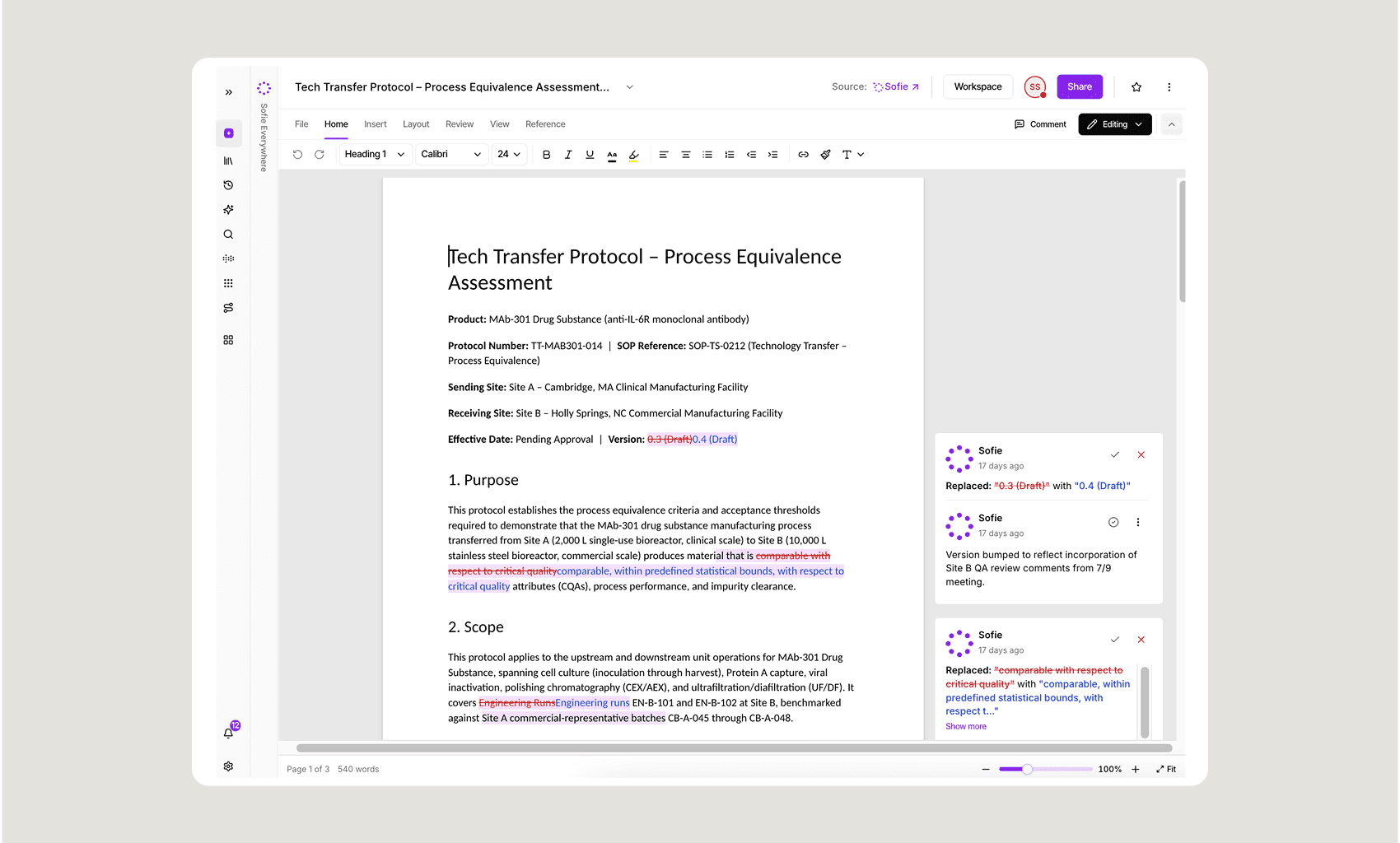
A generic solution only offers surface-level assistance in redlining. The real value comes from an AI solution that can produce a workable, traceable GMP record ready for review. Sofie is a purpose-built AI tool for biopharma that can execute redlining the way teams are used to in Microsoft Word. This means redlining in CoDraft can process a 50-page deviation report in minutes, checking language and structure against the organization’s protocols and the regulatory context loaded into the workspace. It applies the same level of detail across the full document creating a marked document with every change attributable, resolvable, and logged.
The value is not that Sofie replaces your team in the redline. The value is that it streamlines the work that used to take reviewers days and provides a markup ready draft for human review, allowing reviewers to concentrate their expertise on the aspects of the document that actually require judgment. Now your team's first interaction with the draft can move from multi-hour manual redline review to moving the project forward in a meaningful way.
Here are 5 ways Sofie delivers what a generic solution cannot:
Standards-grounded review: Sofie evaluates each proposed change against your SOPs, approved templates, and CMC requirements — not the redline in isolation. Reviewers receive a pre-assessed markup with every departure flagged and every suggestion reasoned.
Precise edit execution: Sofie applies changes through targeted, node-level operations rather than free-form generation. Each modification is anchored to a specific instruction, and revision rounds layer without corrupting the document or the audit trail.
Multi-reviewer conflict resolution: When competing redlines arrive, ask Sofie to consolidate competing redlines, and it surfaces every conflict in a single pass with a summary of what it recommends accepting, rejecting, and why.
Pre-advancement consistency check: Before a document moves forwa
Pre-advancement consistency check: Before a document moves forward, Sofie scans for inconsistent terms, altered regulatory language, and broken cross-references across every section. Not just the ones that were redlined.
Reviewer-independent consistency: Sofie applies the same standard whether it's the first review pass or the fifth. Institutional knowledge gaps and individual reviewer variation don't affect the depth of the markup.
How to Redline a Document with Sofie in Five Steps
The most effective redlining workflow in Sofie follows five steps. The first two are largely setting yourself up for success. The last three are where technical and quality expertise drives the outcome.
Step 1. Bring your document into CoDraft
Upload the incoming document directly into Sofie. We recommend creating a workspace dedicated to your project and importing your Word file into it, then prompting Sofie to create a workable CoDraft from this file. CoDraft will preserve all tracked changes, comments, and formatting. If reference documents exist, such as a prior protocol version, a development report, or a tech transfer summary, we recommend uploading those to your workspace as well. These references give Sofie context about what the document should accomplish so it can evaluate incoming language against the specific intent of the document. As you work, we recommend saving each version to your dedicated workspace. Versions are especially valuable when multiple reviewers are working in parallel or when a document has gone through several rounds of edits with Sofie.
Step 2. Confirm which review mode applies
Before Sofie reviews the document, confirm which mode governs the session. CoDraft operates in two modes: Editing, for direct changes, and Suggesting, for redline-style tracked changes where every proposed modification must be accepted or rejected by a human reviewer before anything in the document changes. For regulated document review in biopharma, Suggesting mode is almost always the right starting point. The document itself does not change until a reviewer acts on each suggestion leaving behind an audit trail.
Step 3. AI-assisted first pass
Once a document is open in CoDraft, ask Sofie to review it in plain language, and it will return a structured summary of what changed, where, and by whom. From there, Sofie can list every tracked change with author attribution, summarize open comment threads alongside the changes they are anchored to, and flag conflicting edits such as adjacent delete and insert pairs. For complex redlines, it can also explain what changed, why it may matter, and what the document said before. A reviewer can then navigate changes one at a time, filter by comments or tracked changes, and separate formatting fixes from substantive edits, with every resolution tracked.
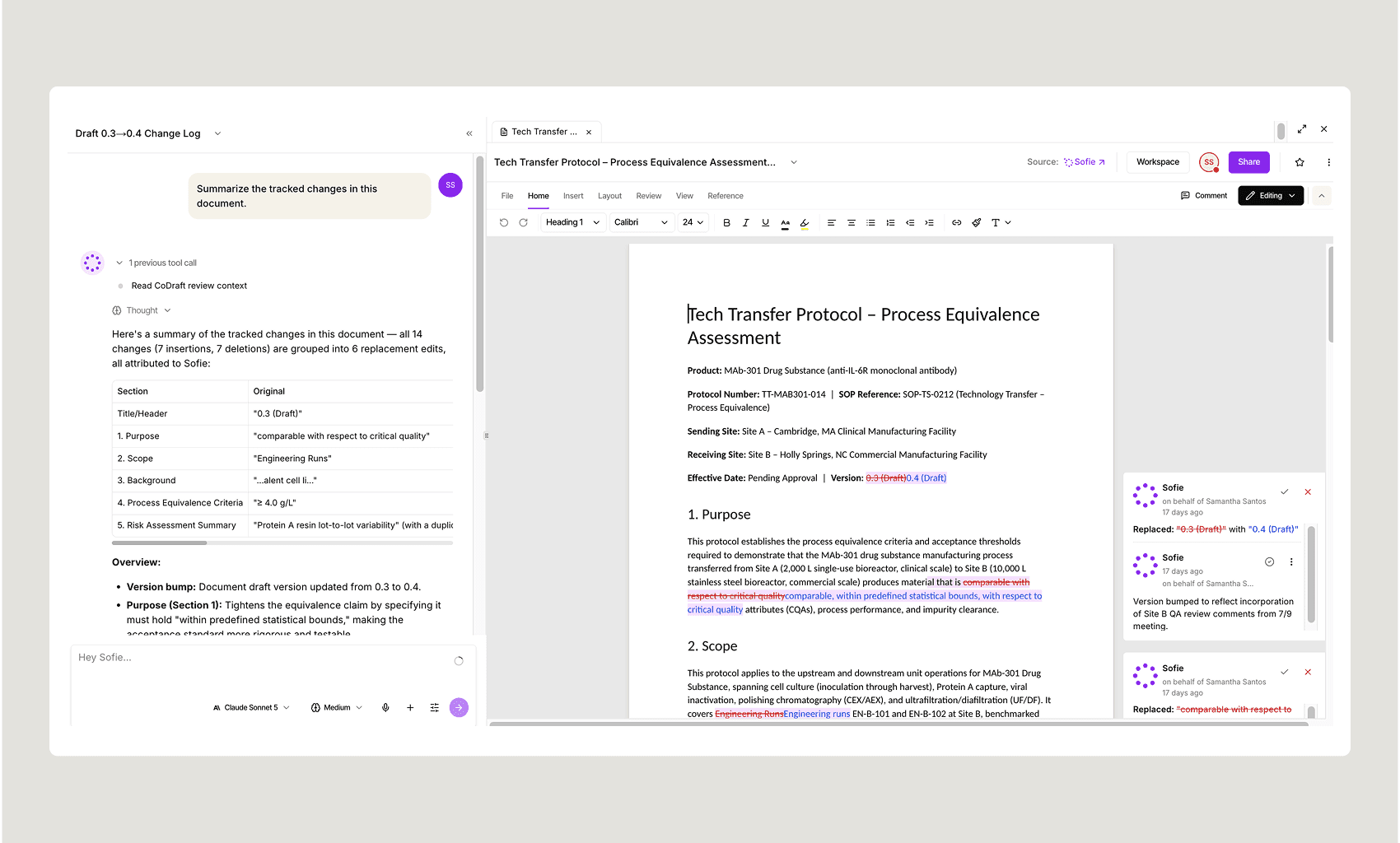
A few ways to work with Sofie once the first pass redline is complete is:
To see all tracked changes at a glance: "Summarize the tracked changes in this document."
To review an imported Word file: "Import this DOCX into a CoDraft. Preserve headings and tables where possible. Then list sections that need QA review."
To get AI-proposed edits without direct changes: "Open the CoDraft and propose tracked changes instead of rewriting directly."
To identify conflicting edits: "Flag any sections where multiple reviewers have made conflicting changes."
To separate formatting from content changes: "Show me only the substantive text changes — skip formatting corrections."
To export a clean final copy: "Prepare this for Word export with all suggestions accepted."
These prompts work whether you are reviewing an imported Word document, a natively authored CoDraft, or a document that Sofie generated from a template or prior analysis.
Step 4. Human review and resolution
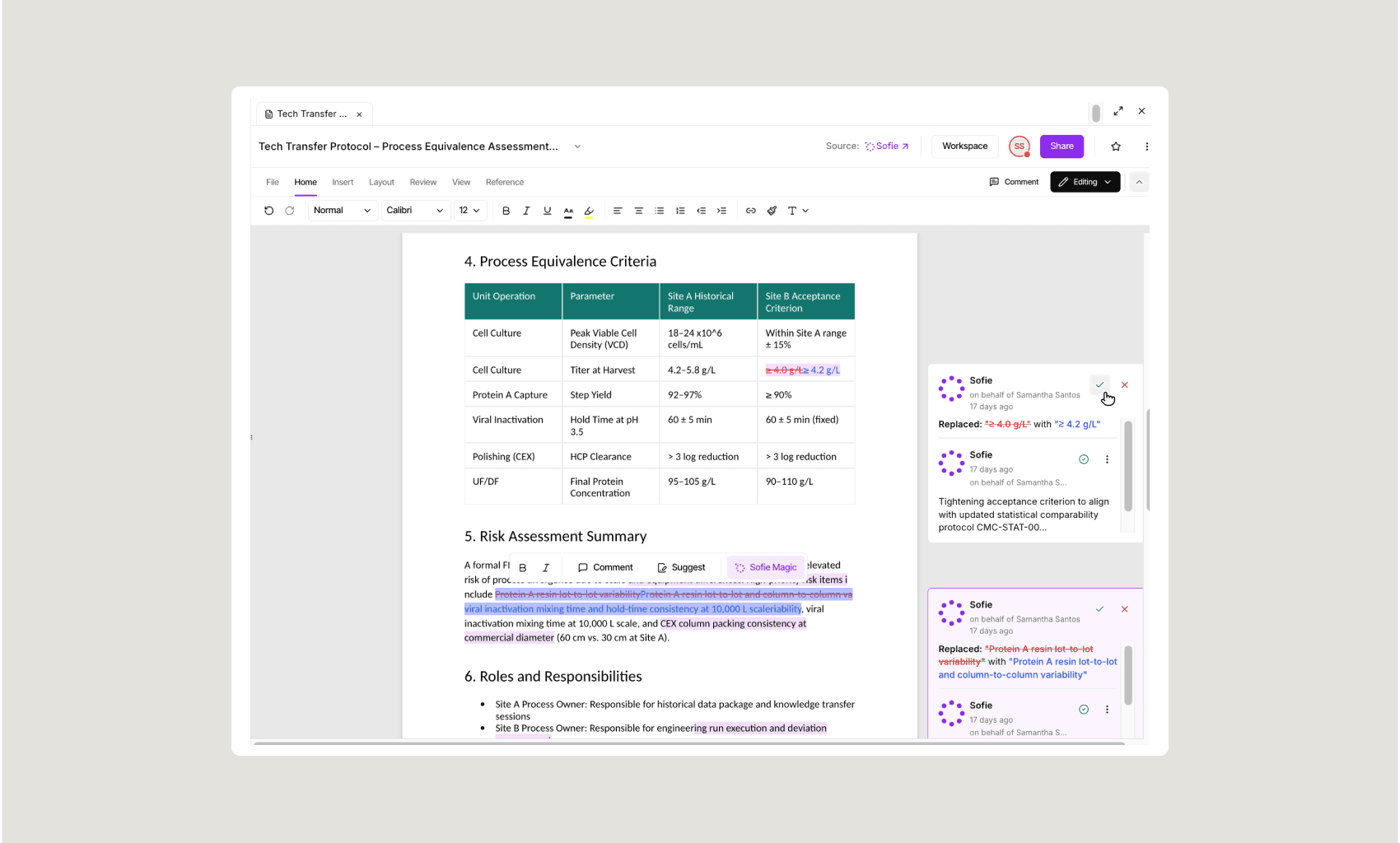
This is where regulatory and quality expertise enters the process. The reviewer evaluates every suggestion, accepting those that align with their protocols, rejecting those that do not, and escalating contested edits for SME or QA input. A suggestion to tighten a manufacturing parameter specification might be appropriate for a late-phase commercial transfer but unnecessarily restrictive for an early clinical process that still has room to evolve. As revisions are made, an audit trail is created to support the document control traceability required in 21 CFR Part 11 environments.
Step 5. Version, finalize, and export
Before sending the markup to the next reviewer or submitting for QA approval, save a named version to your workspace for this project. Named versions protect both the reviewer and the organization if questions arise later about what was changed, approved, or negotiated and why. Export a clean or redlined version in Word format to forward to QA for final review and approval. QA typically generates the PDF version of the finalized document before it's uploaded into the QMS. The version history stays in your workspace, available for audit at any point in the review lifecycle.
The Standards You Set Determine the Review You Get Back
In the workflow above, step three dictates a first pass by Sofie. That step deserves more attention than it typically receives. Sofie operates best against a well-maintained set of reference documents saved to a project-specific workspace, producing suggestions that reflect your organization’s actual quality standards with considerable precision. The more complete that context is, the more the first pass reflects your organization’s specific standards rather than general best practice. That’s why Sofie outperforms generic AI solutions here. It combines that context with a foundation purpose-built for biopharma, rather than a general-purpose model retrofitted for the industry.
A comprehensive review by Sofie comes from three groups of context.
Workspaces: define document-level context, including preferred terminology, standard templates, and escalation thresholds for each regulatory function and framework. A change control record, for example, might specify the affected process or system, the required approval routing, and the downstream documents impacted by the change.
Memories: establish personal preferences like desired writing style and directives. A missing tone or terminology preference is a different type of review standard than an unaddressed deviation from an approved specification, and Sofie's suggestions should reflect that distinction.
Prompts and skills: encourage a specific structure or series of steps to execute a workflow. FDA audit responses must address root cause, corrective action, and preventive action in a fixed order. Tech transfer protocols must confirm process equivalence before addressing scale-up risk. Material specification reviews need supplier certification and compendial compliance confirmed before release. A single generic ruleset applied across all document types will miss these requirements.
The less obvious challenge is maintenance. Document standards shift as products advance through development phases and regulatory guidance changes. Sofie's suggestions are only as good as the directives it has been given. If those standards aren't maintained, the review can feel "slightly off," and in a regulated environment, slightly off can mean materially wrong. That should trigger a feedback loop between human experts and Sofie's institutional knowledge, which means updating workspace documents, memories, prompts, and skills to align with any new standards. These aren't one-time configurations but active partners in getting work done.
For teams just getting started, the best approach is to begin where the standards are already well defined. SOPs and work instructions are natural starting points. These documents have predictable structures, limited variation in approved language, and enough volume that the time savings become visible within the first few weeks. Building confidence and refining your workspace, memory, and skill configurations on these simpler document types creates a foundation for expanding to more complex documents, like tech transfer protocols or CMC sections, over time. Once those standards are producing reliable results, the next question is how to evaluate the accuracy of what Sofie generates and how to build the governance framework around it.
How to Evaluate the Output and Get the Governance Right
Accuracy and governance are the final gate before biopharma teams can trust an AI tool with production work. One of the most common questions we get about Sofie is whether it's trustworthy enough to put into production across the organization. Accuracy determines whether Sofie's suggestions are worth reviewing in the first place. Governance, the framework TransferAI builds internally and you structure within Sofie, determines whether the organization is ready to rely on those suggestions. Both need to be in place before redlining can move from pilot to standard operation.
Factual grounding: Generic AI tools predict statistically likely language from broad training data. It has no grounding in your controlled document library, your SOPs, or the regulatory framework that applies to your product and phase. Domain-specific tools like Sofie ground every output in verifiable source materials and makes reasoning visible so the reviewer can see not just what was suggested, but why.
Human-in-the-loop design: Every suggestion made by Sofie remains a proposed suggestion until a reviewer acts on it. This human-in-the-loop design exists to guarantee that every finalized document reflects professional judgment.
Data security and audit trails: Any AI solution used for biopharma documents must operate under enterprise-grade protocols, including encryption in transit and at rest, strict data isolation so your controlled documents are never used to train external models, and access controls scaled to the sensitivity of the content involved. This is where the domain-specificity of Sofie distinguishes itself. Sofie was built with these guardrails as a foundational framework. When security is built into the foundation of the platform, governance becomes something you can demonstrate, not just claim.
Audit trails are the end product of good governance. The ability to document what Sofie suggested, what a reviewer applied or modified, and the reasoning behind each decision strengthens quality control and reinforces the expertise of your team. Biopharma teams that build this into their redlining workflow from the start simplify inspection readiness, reduce disputes over what changed and why, and give cross-functional stakeholders confidence in the review record.
With accuracy validated and governance in place, the remaining question is what changes about the reviewer's day-to-day work once Sofie becomes part of the standard redlining workflow.
How AI Redlining Changes What Your Team Spends Time On
When the mechanical first pass takes minutes instead of hours, the reviewer's role does not shrink. It shifts. The time that was previously consumed by line-by-line comparison against a template or SOP is now available for evaluating deviations in context, escalating genuinely ambiguous calls to SME or QA, and making the judgment decisions that actually determine whether a document is fit for its intended purpose. The reviewer who used to spend a morning building the markup now spends that morning deciding what the markup should accomplish.
This shift has real implications for team capacity. A quality team that previously needed three days to turn a first-pass markup on a complex validation protocol can now deliver it in one. That compression does not mean the team needs fewer reviewers. It means the team can handle more document volume at the same headcount, or invest the recovered time in the SME and cross-functional work that was previously deferred because the review queue was too long. Halo Pharma's IT function saw this dynamic firsthand after adopting Sofie to consolidate its SOP library. By automating the manual consolidation and review of overlapping procedures, the IT director shifted his time from digging through disorganized files toward the infrastructure and audit-readiness decisions the role actually demanded. He reported that consolidating a 150-document SOP library, work that would have taken 40 hours across several weeks, was completed in about four hours over a few days.
This is not about doing less. It's about doing more with the judgment your reviewers already have, and putting that judgment to better use. This is where teams often see the most meaningful gains, because the volume of documents flowing through quality and technical operations typically outpaces the team's capacity to review them manually. Freed from that bottleneck, reviewers can move across more projects, more tech transfers, and more client engagements.
Where Document Review Goes From Here
The shift from manual markup to redlining with Sofie is not a future trend for technical teams. It is happening now, across CDMOs managing clinical-to-commercial transitions, biotech manufacturers accelerating tech transfer timelines, and cell and gene therapy organizations navigating the regulatory complexity of novel modalities. The teams that have adapted to this workflow change are doing it because it produces faster review cycles, more consistent adherence to quality standards, and a better use of every expert’s time.
The distance between where most teams are today and where the leading organizations are operating is shorter than it appears. A single pilot on a high-volume document type, a small group of experienced reviewers evaluating the output, and a clear governance framework are all it takes to start. The teams that begin now, on their own terms, will be better positioned than those who adapt later under pressure from partners and regulators who already expect it.
Ready to see it in action? Upload a document with tracked changes into CoDraft and ask Sofie to summarize the redlines. The first review takes just a few minutes.