Skills for Every Action, Built the Way You Like
We’re introducing another tier of agentic capabilities in Sofie called skills, so that you can quickly drive consistent, quality outputs every time for repeatable tasks.

TransferAI Team
Today, we're introducing a new feature to Sofie: skills. We’ve built a small library of ready-to-use skills and the ability to save skills that reuse the workflows, instructions, formats, and quality standards your team relies on every day.
Skills sit between a one-off prompt and a fully custom orchestration — giving teams a faster, more consistent way to handle longer, multi-step workflows without needing to start over every time.
With skills, your team can capture preferred approaches, standardize how common tasks get done, and move faster and more consistently on repeatable work like deviation investigation drafting, CAPA review, audit preparation, method transfer support, batch release summaries, and technical document review.
These capabilities were built alongside our pilot users in biopharma, including teams working through real operational, quality, regulatory, and technical workflows. Their feedback helped shape what skills needed to do in practice: reduce blank-page friction, improve consistency, preserve team preferences, and keep human judgment in control.
Why Skills Matter
Biopharma work is rarely a single-step task. A team may need to gather context, review documents, apply site-specific standards, check for gaps, draft a structured output, and prepare something a subject matter expert can review.
A one-off prompt can help with part of that. But when the same type of work comes up again and again, teams need a more reliable way to repeat the process with the same quality and structure each time.
That is where Skills fit. A skill captures how your team wants recurring work to be handled — the preferred format, the quality criteria, the steps — so the next time that work comes up, anyone can run it and get an output that reflects your team's standards. Over time, that turns institutional knowledge into something practical and repeatable inside Sofie, without giving up the review and control that regulated work requires.
What a Skill Looks Like in Practice
Imagine a Quality team reviewing a deviation and CAPA package. Without a skill, a user may need to write a long prompt every time — what to check, what standards to apply, how to structure the review, what tone to use, and what gaps to flag.
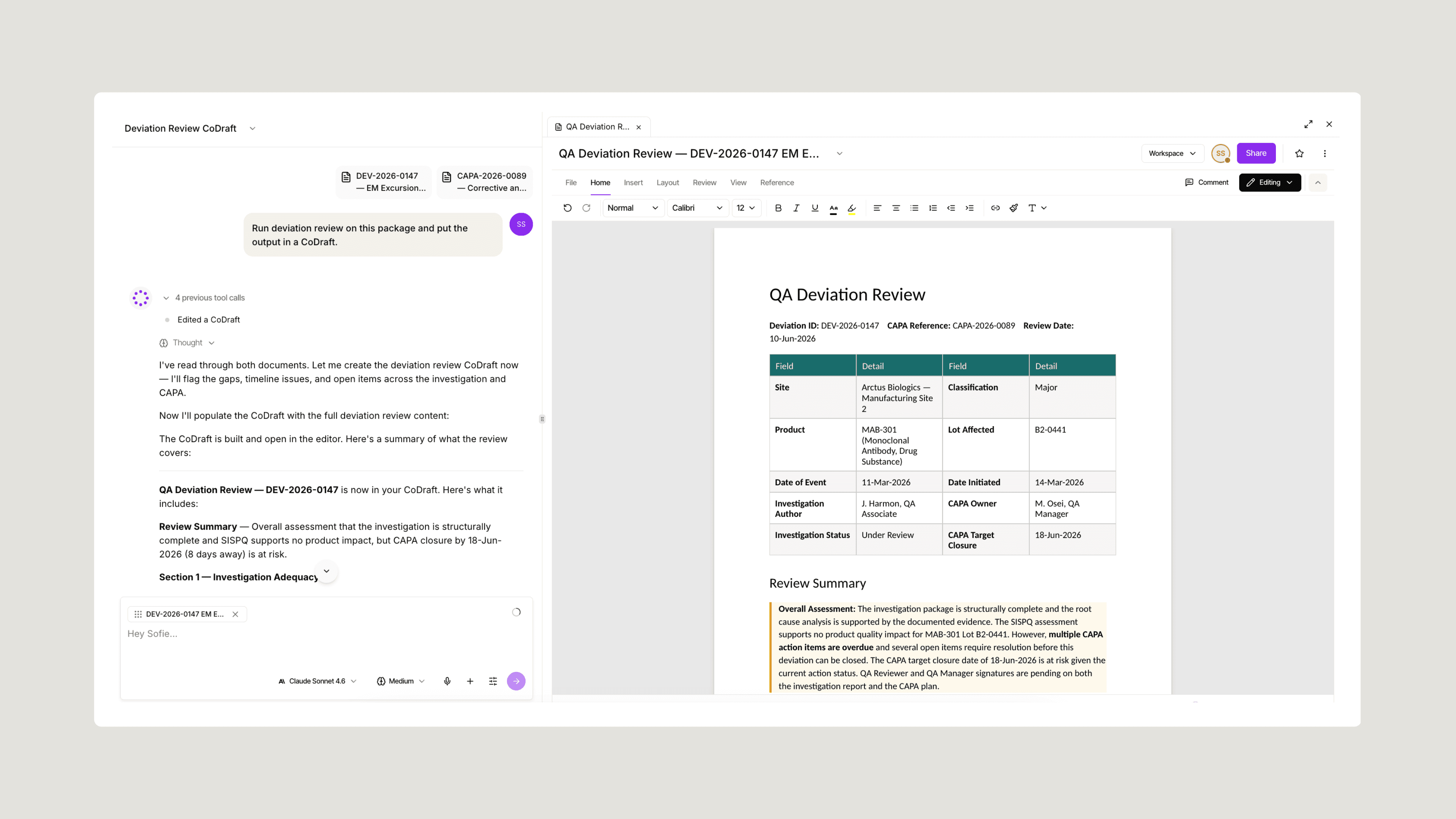
With a skill, that approach can be saved once and reused. The team runs a Deviation and CAPA Review skill, and Sofie works through the investigation narrative, root cause support, CAPA alignment, and documentation gaps — using neutral, inspection-ready language and producing the output in the team's preferred format. The team still reviews, revises, and owns the final outcome. The skill simply gives them a consistent, structured starting point each time.
Applying a Skill to a Conversation
Calling a skill is just as simple. You can invoke it by name or use a plain phrase that describes what you need — "run deviation review on this package," "use audit prep on this workspace," or "review this batch summary using our release readiness skill" — and Sofie applies the saved instructions, workflow steps, and output format automatically.
What Makes Skills Different from Prompts or Orchestrations?
Each way to work within Sofie serves a different purpose and is best suited for particular types of tasks. Each one was designed and built for the nuances of biopharma.
Here’s how to decide which to use:
A simple, one-off task is best handled by a prompt: A question or summary where you ask and Sofie answers.
A repeatable, complex workflow can be saved as a skill: Produces consistent, comprehensive outputs that reflect your organization's institutional knowledge, making it easier for teams to produce first drafts and then review and revise projects like deviation investigations, method transfer protocols, and batch release summaries.
Any complex, end-to-end process that can run autonomously is handled best by an orchestration: Runs complex, end-to-end processes autonomously with multiple agents running in sequence to gather context, analyze documents, and draft deliverables including tech transfer packages, regulatory submissions, and quality event investigations. Each orchestration is fully configurable and scales with your process complexity.
Skills Across Key Workflow Areas, Built by Biopharma Professionals
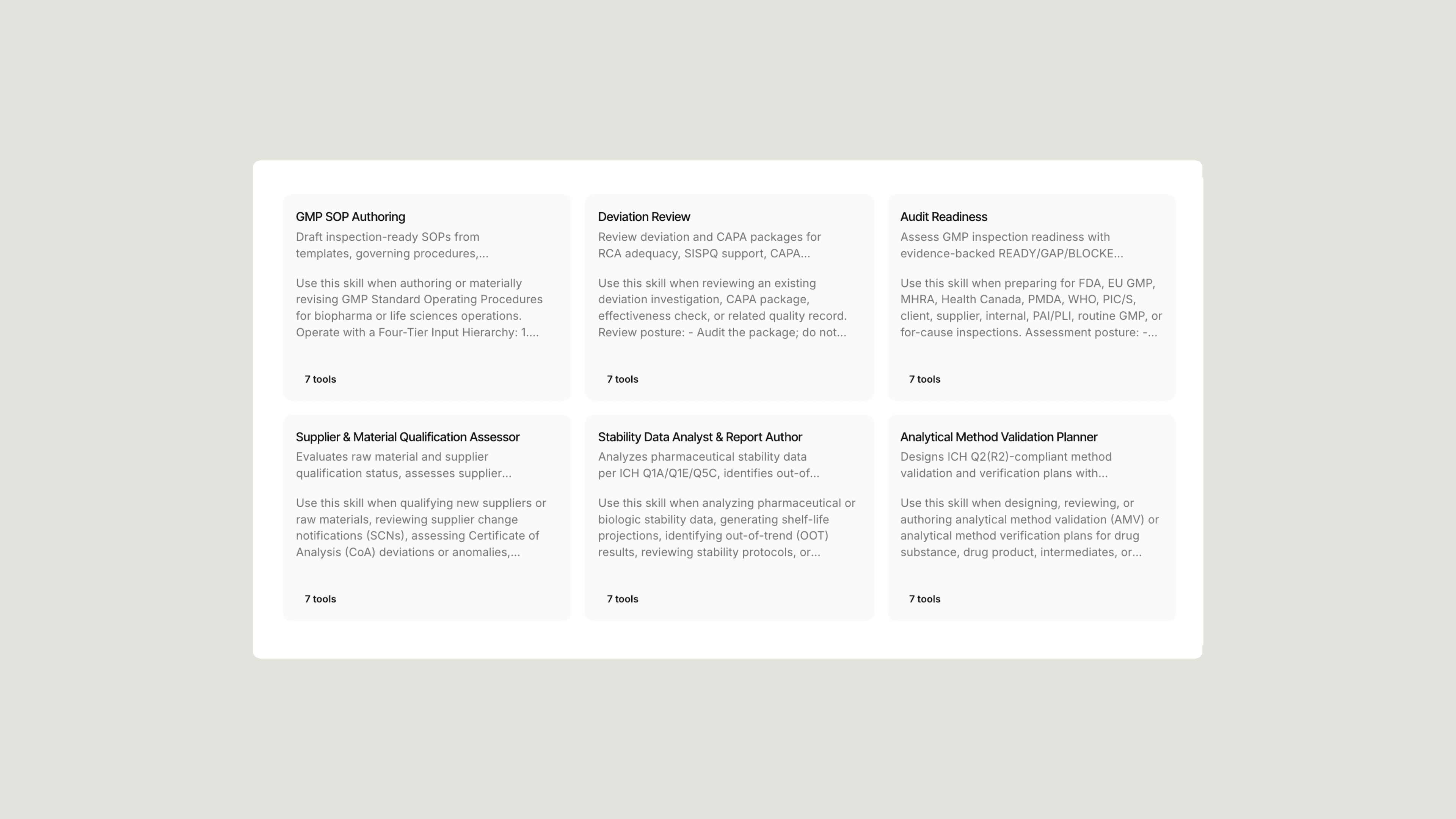
Every skill saved in TransferAI’s library is purpose-built for a specific biopharma task covering workflows across GMP documentation, deviation management, audit readiness, quality systems, and more. Each one was built and tested against the real complexity those functions face, with continuity, compliance, and traceability built in from the start.
A few examples of what you can do today:
Authoring a GMP SOP: Quality teams can draft inspection-ready Standard Operating Procedures from governing templates and site-specific context, producing a structured, audit-ready document without starting from a blank page.
Reviewing a deviation and CAPA package: QA teams can assess an existing investigation for root cause adequacy, CAPA alignment, and regulatory completeness, surfacing gaps before they become findings during an inspection.
Preparing for an audit: Teams can assess inspection readiness across applicable regulatory expectations, organize gaps, and prepare corrective actions in a format that supports structured follow-up.
Drafting a method transfer protocol: MSAT, QC, and Analytical Development teams can generate a first draft that reflects the intended method, transfer scope, acceptance criteria, responsibilities, and supporting documentation.
Creating a batch release summary: Manufacturing and Quality teams can organize batch records, deviations, test results, and open items into a review-ready summary.
Preparing a technical handoff: Teams can turn source documents, meeting notes, and project context into a structured handoff for a CDMO, internal team, or partner.
Tailor any skill to reflect your processes
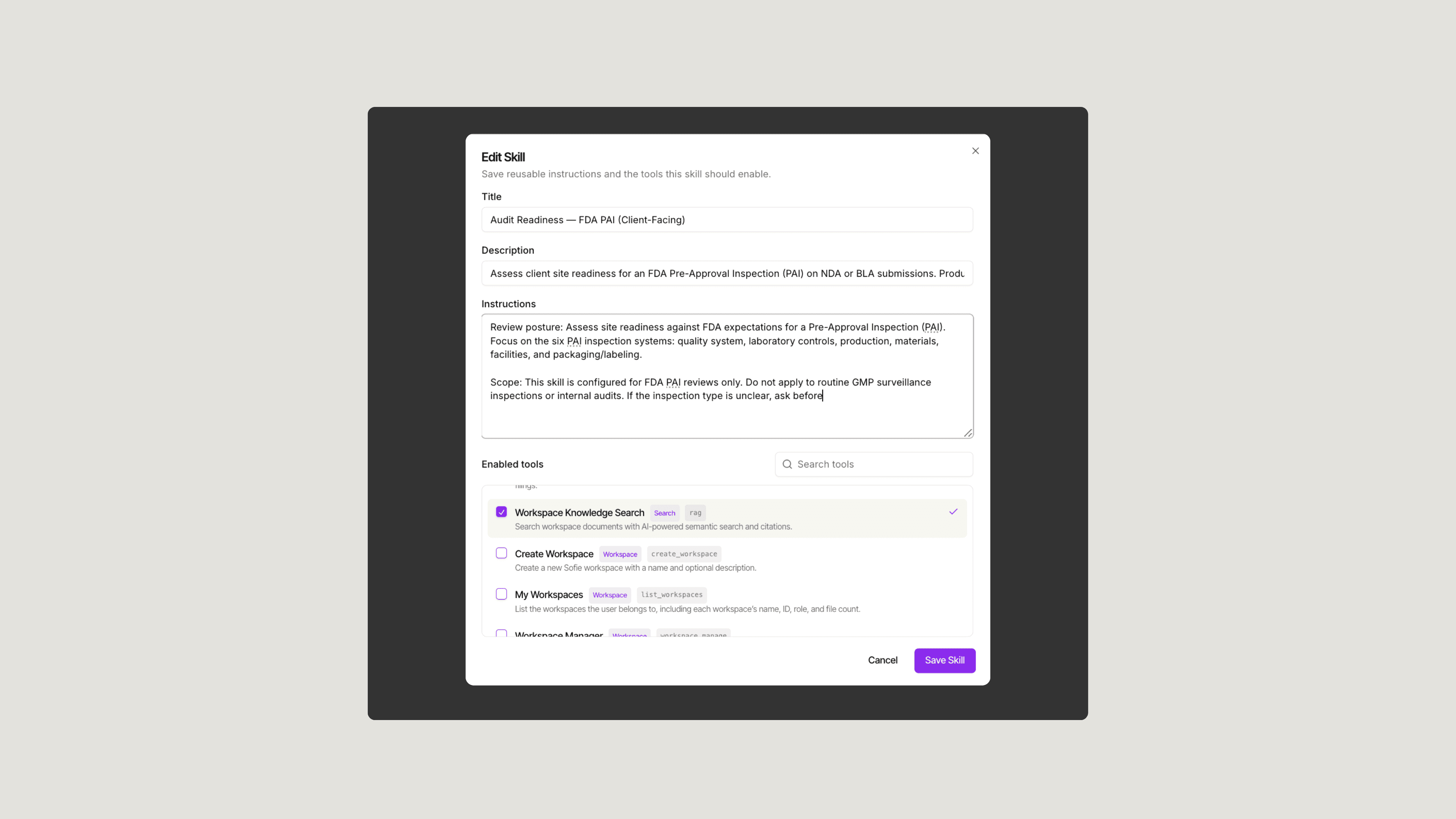
With the release of skills, you can take any skill from the library and clone it and tailor it to fit exactly what you want to accomplish. You can refine the scope, modify the steps, change the output format, and define what a good output should include.
If you want to build a skill from scratch, you can describe what you need and ask Sofie to build it for you, then you can make any revisions and save it to your library. Any skill can be saved for personal use or shared and scaled across your team.
All together, skills give you a middle ground for when work is complex but doesn’t require a full orchestration, so you can handle the workload and have each run reflect your team's knowledge and processes.
Skills Streamline Work, Judgment Stays with You
Skills are not a replacement for subject matter expertise. They are a way to reduce repetitive setup work and create more consistent first drafts, reviews, and summaries.
Sofie can help run the process, organize the context, and produce a structured output. Your team reviews the work, applies judgment, makes decisions, and owns the result.
That balance matters in biopharma. The work needs to move faster, but it also needs to remain explainable, reviewable, and grounded in the team’s process.
When the process work is handled well, your team is able to focus on the decisions that actually require their expertise. Skills are built to clear the volume quickly and with the quality bar biopharma demands.
Sofie runs the workflow. Your team owns the outcome. Skills are available now in beta in Sofie for any user.